
Watch your AI work, on the biggest screen in the room.
Claude Code, Codex, OpenCode run for hours inside a laptop window. Plug this device on the back of your TV and extend the visual experience of that session. You see and learn more, catch problems early, and guide the AI at work.
- ✓ Works with Claude / Codex / OpenCode sessions
- ✓ Dynamic UI, generated on demand
- ✓ One AI drives many screens
- ✓ Verifiable, replayable visuals
- ✓ Uses the TV you already own
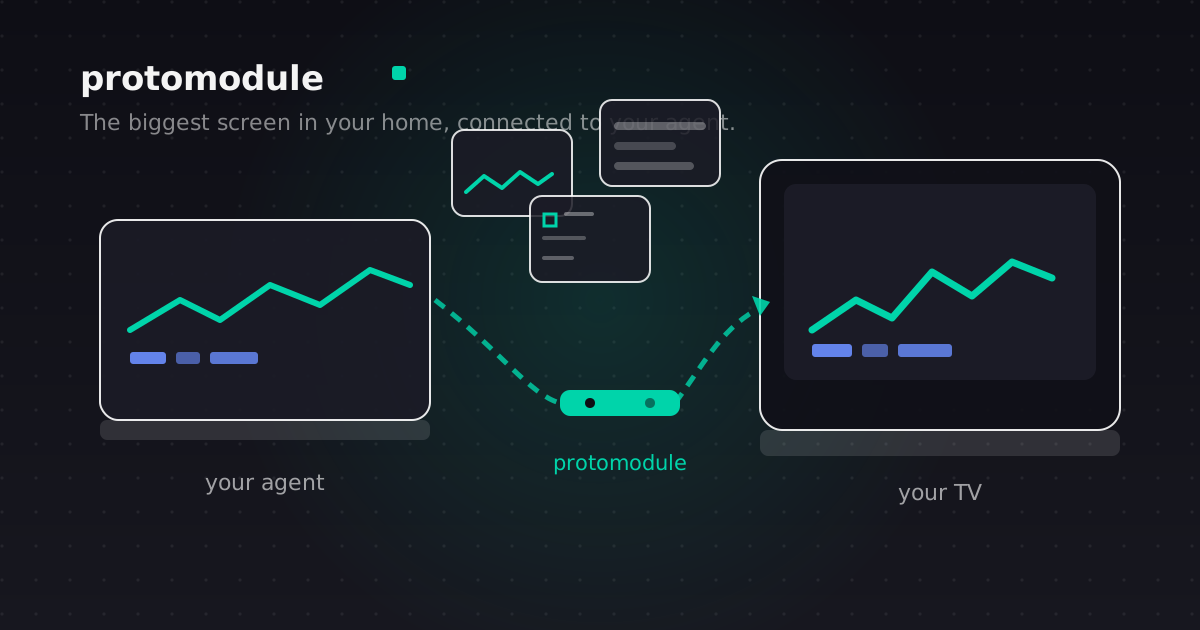
What makes it different
The screen changes with what matters. You see the right thing at the right time. You and your AI share one timeline.
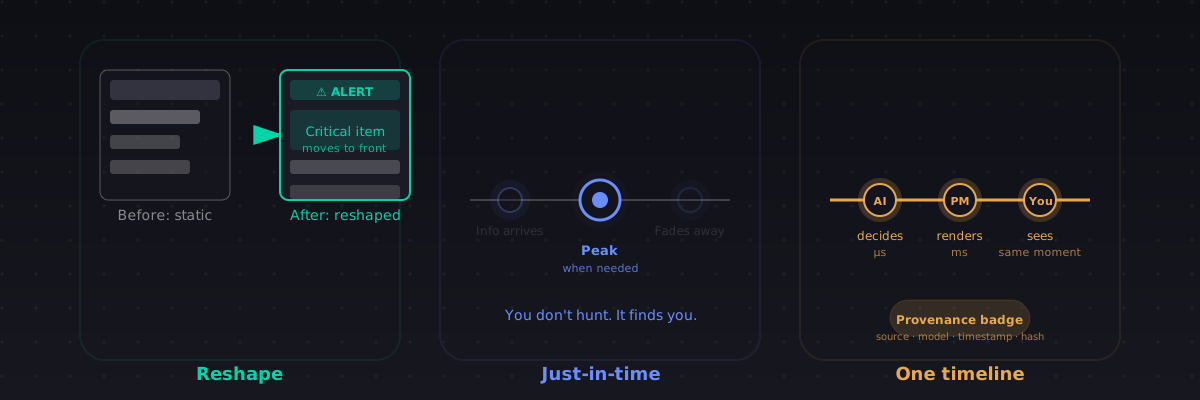
Reshape
The screen reorganizes itself around what matters right now. Critical alerts move to the front — so you see them and act immediately.
Just-in-time
Information appears when you need it and fades when you don't. You don't hunt for the signal. It comes to you at the moment it matters.
One timeline
The AI on your laptop and the TV in your room share the same moment. What the AI sees is what you see. When you guide it, you're both looking at the same truth.
What appears on screen
Your AI pushes data. The TV turns it into meaning.
The screen is never static. As your AI works, it pushes live data — numbers, plans, decisions, messages, media. ProtoModule processes that stream in real time and renders the right visual: a chart that redraws as numbers arrive, a progress bar that moves as work completes, an escalation that lights up when your AI needs you. When the moment passes, the visual fades.

Mission Board
Multi-session work at a glance — progress, current task, blockers, ETA.
Chart
Live data viz — line, bar, pie, area, scatter. Animates to new state, up to 10k points.
Diagram
Architecture and process maps — Mermaid, flowchart, Graphviz. Crisp SVG that re-lays-out on change.
Diff
Code review side-by-side. Your AI's changes highlighted, ready to approve or redirect.
Log Stream
Live output, virtualized. 10k lines buffered, failing tests highlighted in red.
Data Table
Tabular data that sorts, filters, and updates in real time.
Markdown
Prose, code, math, tables — streaming token by token into clean layout.
Action Button
Oversized buttons for approve/pause/dig-in — readable from ten feet.
Media Frame
Images and video up to 4K. Blurhash placeholders while loading.
Nine components, each with strict rules. No raw HTML. No JS injection. No arbitrary code. The same spec renders identically on every screen — same result, every time.
The buy feature
"How's my mission going?"
Big jobs take hours or days across many sessions. Your AI runs a plan and the TV shows a Mission Board: progress, current task, blockers, ETA. You go make coffee. The TV tells you when it needs you.
Progress card
One feature or milestone — status and percent. Laid out as a grid, not a fixed screen.
Status card
Current skill, ETA, owner, agent. What's happening right now, at a glance.
Blocker card
A decision point needing the human. Oversized buttons, readable from ten feet.
Summary card
Mission header and overall percent. The answer to "how's it going?" in one number.
Made for two. The Mission Board is built for two people to stand in front of the TV and decide together. On a laptop, one person clicks. In front of the TV, two people make one decision.
Alerting is deliberately quiet: silent for 10 min, soft pulse for 20, voice prompt at 30, phone notification at 60. Each step fires once. It respects your flow without letting a six-hour job stall.
Beyond one screen
One agent, many screens — all on one timeline.
One AI, many screens. Map Claude to one TV, Codex to another. Put a live dashboard on eight screens in eight stores. Show a room a presentation your AI builds as it goes. Every screen is another window onto the same work — and another place where the right information reaches the right person at the right time.
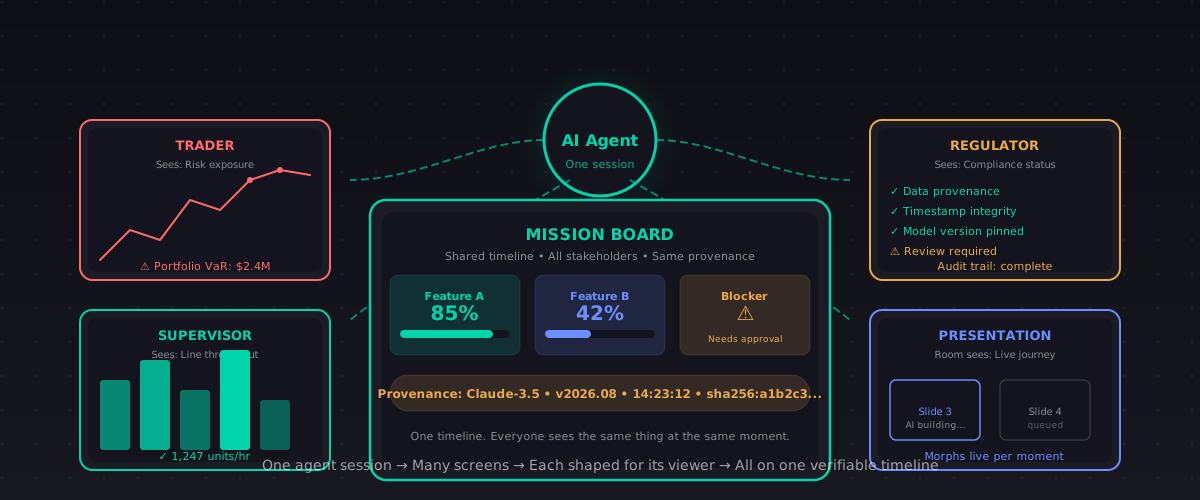
Reshape for the role
One display, many views. The trader sees risk. The supervisor sees throughput. The regulator sees compliance. Same data, different rendering, by role — from one agent session.
One timeline, many stakeholders
The CEO, the regulator, the operator, the AI — they all see the same thing at the same moment, with the same provenance. No lag. No ambiguity.
Presentation mode
Present to many: the agent orchestrates real-time visuals to screens in the room. The display morphs around what matters. The audience sees what the AI sees, the moment it matters.
Trust & compliance
See exactly what happened, whenever you need to.
Every visual is recorded and traceable — a clear record of how each screen was generated. That supports oversight, accountability, and compliance with frameworks like HIPAA, SOC 2, GDPR, and ISO 27001.

Environmental responsibility
The greenest screen is the one you already own.
Every LCD is a thin envelope of liquid-crystal chemicals — loosely sealed, persistent, released at every stage of a display's life. In 2026, those chemicals were found in the brains of endangered dolphins, having crossed the blood-brain barrier through the food chain. They can't be recycled easily: no industrial-scale process exists. The carbon to make them was paid years ago, and over 60% of replaced TVs were still working. ProtoModule's answer isn't a better recycling process. It's to give the screens already here a reason to stay turned on.
213 kg
CO₂e to manufacture a 42" LCD panel — carbon paid before you turn it on
3–5 min
Breakeven disassembly time — after that, labor exceeds material value
76–99%
Environmental benefit from refurbishment — keeping screens in service
5.6 yr
Average life of replaced flat-screen TV — down from 10–12 yr for CRTs
Recycling isn't the lever. Refurbishment is. A 2024 life-cycle assessment of LCD waste in Santiago, Chile — 315K monitors discarded annually, only 5% formally managed — found refurbishment accounted for 76–99% of environmental benefit across every category. The highest-leverage thing a product can do is make screens worth keeping in service.
Repurpose, don't replace — ProtoModule turns the TV you own into a work screen. No new panel.
One stick per screen — One device reshapes the same display for every use.
Repair-friendly hardware — Designed to stay in service and be fixed, not swapped.
AI utility as anti-waste — Give a working screen a job worth turning on for.
Local-first — One screen replaces a rack of devices, all of them LCDs.
Why change, why now, why ProtoModule
One stick. Every visual. One timeline.
Why change
Your AI works in a tiny terminal window. You see the last message, not the run. You can't guide what you can't see — and the work suffers.
Why now
AI tools are everywhere, and millions of TVs sit dark. The missing piece is the screen that closes the loop between you and your AI.
Why ProtoModule
One stick turns the TV you own into that screen — charts, progress, plans, escalations, live. See what your AI is doing. Guide it better.
Five minutes to set up. No AI code on the device. No new screen headed to a landfill.
ProtoModule is in stealth: no price plans, no pre-orders, no launch date. The owner is a software engineer working at a bank, and the project is based on research from SideSpin.com. From box to big screen in under five minutes. When it's ready to leave the workshop, you'll hear it here first.